

Some graduates leave university with a degree. Khalifa Shu’aib left with a mission.
The former NUESA President at ABUAD in 2023 has since launched a smart fish farm, built a portfolio of innovation projects, and recently submitted two patent applications for inventions that tackle food security and healthcare accessibility, two of the most pressing challenges facing Nigeria and the wider continent.
We sat down with Khalifa to hear the story in his own words: how ABUAD shaped him, what drives his relentless building, and where he’s headed next.

Future Fish Farms: Engineering Meets Aquaculture
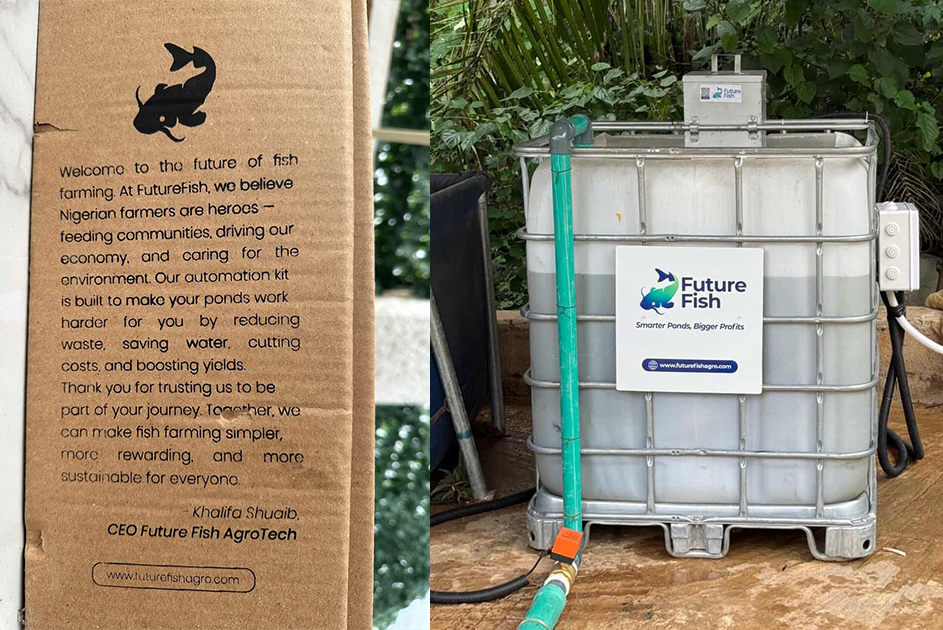
At the heart of Khalifa’s entrepreneurial journey is Future Fish AgroTech, a data-driven aquaculture venture using IoT automation to transform fish farming in Nigeria. The company was founded shortly after his graduation in 2023, and has since expanded to farms in Abuja, Lagos, Oyo, and Kaduna.
Can you tell us about Future Fish Farms , when did you start it, your reasons, and how are you coping with the economy at the moment?
Future Fish AgroTech is the data engine for African aquaculture, focused on bringing practical, scalable technology to local farming. The company was founded shortly after my graduation in 2023, when we built our first prototype of an IoT-based modular aquaculture automation system that handles the heavy lifting of commercial farming, specifically automating water chemistry management and feeding systems for high-yield African catfish (Clarias) production. By continuously capturing critical data points on water quality, feeding behaviours, and environmental triggers, we are building a predictive engine that gives farmers total control over their operations, reduces mortality, and guarantees predictable yield.
The economy makes things a bit tougher, especially because accessibility is very important to us. For now, we are building for the local market, so our product must reflect local realities in terms of cost, ease of use, and functionality. Since our first version, we have continued to innovate, making several improvements to ensure those values are upheld without compromising on quality.
Where do you see your company in the next five years?
We envision a future where every fish farm in Nigeria is an automated one. We already have farms running in Abuja, Lagos, Oyo, and Kaduna, and over the next five years our goal is for Future Fish to become synonymous with Nigerian aquaculture as we grow our coverage across the country.

Two Patent Applications – Two Major Problems
Beyond his farm, Khalifa has submitted two patent applications for inventions targeting food security and healthcare accessibility, reflecting a philosophy that engineering should serve society at its most foundational level. His portfolio of innovation projects continues to grow, and 2026 is shaping up to be one of his most ambitious years yet.
Do you have any other projects we should be expecting from you?
There will always be projects to expect from me! 2026 is my year of properly venturing into robotics. I am currently working on an automated conveyor line for material sorting and building an industrial-grade 6-axis robot arm. I chose these projects for two reasons: first, they represent classic use cases of robotics in an industrial and manufacturing setting; and second, I strongly believe it is high time we took our industrialisation goals seriously in Nigeria. Young engineers should do what they can to contribute, working on projects that solve real, local problems for Nigerians.
Where do you see the future of mechatronics and innovation heading in the next decade?
The next decade is shaping up to be a genuinely exciting time for engineers, and I think a few forces are converging in a way that is hard to ignore.
The first is industrialisation. We are watching it happen in real time. Projects like the Dangote Refinery, already the largest single-train refinery in the world and now being expanded toward becoming the largest refinery anywhere on the planet, are proof that Africa is capable of world-class industrial output. That scale of ambition demands engineers, and it creates demand for automation, precision systems, and smart manufacturing that mechatronics engineers are uniquely positioned to deliver.
The second is AI. For a long time, AI was the bottleneck that held robotics back. Perception, decision-making, and real-time inference were all too limited or too expensive for widespread deployment. That barrier is pretty much gone now. AI is now infrastructure and no longer a novelty feature. With the explosion of open-source models and frameworks over the last couple of years, tools that were once the exclusive domain of well-funded research labs are now accessible to anyone with the skill to use them. The robotics space today honestly reminds me of the early internet era: a lot of open platforms, a lot of diverse use cases being explored in parallel, and real uncertainty about which paradigms will dominate. Just as the dot-com bubble eventually gave way to the companies and infrastructure that define our digital world today, I believe we are laying the foundations for a similarly transformative robotics industry.
The third is opportunity for Nigerians specifically. The demand for engineers is only going to increase, and I genuinely believe this is one of our greatest advantages as a country right now. We have the talent; what we need is more people willing to apply it to hard, physical problems.

Building a Company as a Young Nigerian
When did you get the motivation to open your company and how was the process?
Even though we had been operating since 2023, we only officially registered in 2024. By that point we had been gaining a lot of traction, and it became important to obtain the necessary certifications and compliance to build customer trust and qualify for grants and competitions. Registering with the CAC was actually quite straightforward, easier than many people expect, especially with their updated registration portal. I genuinely urge young people to take advantage of it and formalise their businesses. It is the most responsible way to manage your finances and establish your presence with the government.
As a young Nigerian, what difficulties did you have building your company?
Working with corporate entities, and especially government, often comes with a great deal of bureaucracy, sometimes for understandable reasons. Navigating that red tape was a real learning curve for me. Stakeholder management is a skill every business owner must develop, because it only becomes more complex as you grow.
What ABUAD Built in Him
His role as NUESA President gave him experience in advocacy, coordination, and student governance — skills that have clearly translated into how he builds and leads his ventures today. His story is one that current students and recent graduates should find both inspiring and instructive.
Can you tell us the most memorable moments while you were studying at ABUAD?
Commissioning the renovated College of Engineering lobby back in 2023 stands out most to me. It was a facelift the college desperately needed at the time, and staff and students alike were genuinely pleased with the fresh look it gave the building. There was an uplifted energy you could almost feel walking through those halls.
I am very big on capacity and skill development, so organising ABUAD’s inaugural Engineering Summit and Internship Registry, where students gained insights from real industry trailblazers and over 50 direct internship placements followed, is something I remember fondly as well.
And how could I forget the final year basketball tournament? A five-game series that went all the way down to the wire. The rush when we claimed our gold medals was like nothing else I experienced during my time in university.
What experiences did you have at ABUAD that were pivotal in your career?
Serving as NUESA president in my final year gave me first-hand leadership experience that no course could teach. Being responsible for the outcomes of 2,000+ students made the responsibilities I encountered later in my career feel more familiar and less daunting.
In my third year, I developed a location-tracking attendance system that was later adopted by the College of Engineering for that academic year. It was my first experience building for real-world use, and it taught me a lot about prioritising what actually works and managing user feedback constructively.
Interactions with lecturers like Prof. Salami, Prof. Giwa, and Dr. Azeez also left a lasting impression. They shared valuable lessons well beyond academics that I will carry with me for life.

The Person Behind the Builder
Who would you consider as your role models?
Engr. Shehu Tijjani Abdullahi is someone I have enormous respect for. He doubles as an innovator and entrepreneur, and I admire him greatly for acting on one of the most underutilised opportunities in Nigeria: electronics manufacturing.
He Shijie and Mark Rober have also been major inspirations to my builder persona. Watching them use their deep technical knowledge to construct larger-than-life projects has always pushed me to think bigger.
What do you generally do to stay motivated?
I have a huge whiteboard in my room facing my bed, covered with goals for the day, the week, and the year. Seeing those objectives every morning is a motivation booster I tend not to appreciate enough. There is something about crossing off a completed task that gives me a real dopamine hit.
I also try to rest as much as I can. Even though I still mostly work on weekends, I acknowledge that I am not a robot (I wish I were) and that rest is genuinely important for maintaining balance and keeping motivation alive.
Lastly, I count myself very lucky to be working on something I love. Most of the time, work does not feel like “work” at all; it feels more like my purpose. That is one of my unfair advantages, and I try to use it to the fullest.
What do you do to relax and blow off steam?
I enjoy playing sports, mostly football and basketball, but I am always happy to try something new. Getting a good sweat in always gives me the energy I need to take on the week ahead. I also journal now and then. Writing down my thoughts brings me a lot of peace and helps bring structure to a mind that tends to run on overdrive most of the time.
A Builder’s Blueprint
Khalifa Shu’aib’s story is not just one of individual achievement. It is a blueprint for what is possible when engineering education meets ambition, community leadership, and a deep belief that technology should serve real people solving real problems.
From the engineering halls of ABUAD to patent filings and automated fish farms across four Nigerian states, Khalifa is writing a chapter that the entire alumni community can point to with pride — and that the next generation of ABUAD engineers can build on.
Follow Khalifa’s journey on LinkedIn or Visit the Fish Farm Official website at www.futurefishagro.com
Have any thoughts?
Share your reaction or leave a quick response — we’d love to hear what you think!
-
 1
1
-
-1
-
0
-
0
-
0
-
0


